A personal essay about teaching three HSC subjects I barely knew, learning to fly over a wartime airfield, and meeting a woman who remembered 1905 — and what happened when I used AI to recover it all fifty years later. This is a 15-minute read. The payoff: understanding what AI can actually do with a lifetime of experience you haven't yet shared with your children.
Walter Adamson · 2026
"The teacher who knows exactly what they are about to say teaches the content. The teacher who is still working it out teaches the student how to think."
Mildura, 1971
Mildura was not the plan.
I followed a woman there. She had been assigned by the Victorian Education Department to teach in Red Cliffs, a small town fifteen kilometres south of the Murray River in the far northwest of Victoria. I had been sent there by something the Department had no administrative category for, which requires no formal qualifications and takes no account of career plans.
I was twenty-two. It was early 1971. I was one subject short of a Bachelor of Science from the University of New South Wales — five years of evening study, attending lectures after full days of work, ever since my father had explained to me at eighteen that I was now financially self-sufficient by his decree. I had High Distinctions in first-year Physics and Chemistry, a foundational knowledge of mathematical statistics, and no particular plan for what came after the degree I hadn't yet finished.
The first thing I did when I arrived in the Sunraysia region was pick grapes. I mention this not for sympathy — the work was fine — but because of what I noticed while doing it. The irrigation channels that made the whole enterprise possible were engineered with the same logic as a circulatory system. Without them, the semi-desert of northwest Victoria stays semi-desert. With them, it produces table grapes, citrus, dried fruit, and an entire regional economy. Everything in Sunraysia was deliberate. Everything was planted against nature and thriving precisely because of it. I have spent a lot of my working life in systems that operate on the same principle, and Mildura was where I first noticed it.
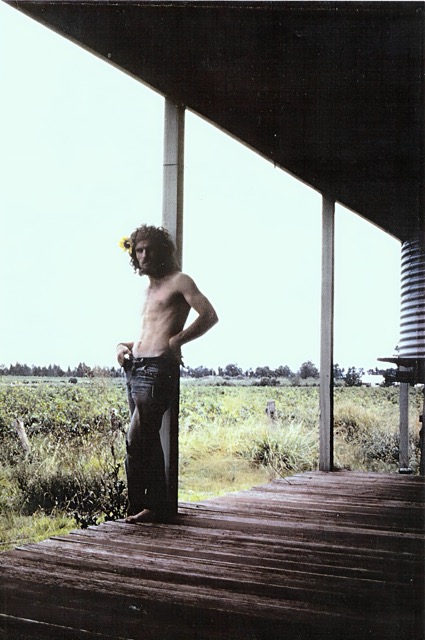
Sunraysia, 1972. Between grape-picking and teaching — the flower was my own editorial decision. This is the twenty-three-year-old Sister Mary McAllen would shortly hand three HSC subjects to.
When the harvest ended, I needed a permanent job. I had a strong science background. I drove into Mildura and presented myself at the high school.
The door that closed
The principal was not unkind about what came next. He told me, quite directly, that he was sending students home one day per week because he had no science teacher. Then he told me he could not hire me.
The Victorian Secondary Teachers Association (VSTA) had been running an aggressive campaign since 1968: the "control of entry" blockade. No completed degree, no Diploma of Education, no appointment in a government school. By 1971, this included an 11-week strike at Maribyrnong High School and a state-wide ban on uncertified teachers. The union's framing was not unreasonable — you wouldn't hire an unqualified electrician — but the outcome in a regional city like Mildura was something I have thought about ever since. A school was actively failing students rather than employ someone who could teach them. The system designed to protect the profession was damaging the very people the profession existed to serve.
I remember feeling irritated rather than defeated. There is a meaningful difference between those two reactions. Defeat makes you go home. Irritation makes you look for another way in.
"Try St Joseph's College," the principal said. "Up the road."
The door that opened
Sister Mary McAllen had just become principal of St Joseph's College in 1972. It was a co-educational Catholic school — established by the Sisters of Mercy in 1906, exempt from VTU jurisdiction, with the authority to hire on the basis of what a person actually knew rather than what certificates they held.
She interviewed me. She hired me.
A few weeks later she came back and asked whether I could also take the HSC Chemistry class. A few weeks after that, the Geography class as well.
By 1972 I was teaching Biology, Chemistry, and Geography at Higher School Certificate level. Three subjects simultaneously. In metropolitan schools at the time, each of those subjects would have had a dedicated specialist. The HSC was a high-stakes examination — those students' university places depended on it. Sister Mary McAllen had taken an unqualified twenty-three-year-old with a near-complete science degree and no teaching qualification and given him the school's entire science and geography programme.
HSC BiologyHSC ChemistryHSC Geography
I have always been grateful for this. Not primarily because of the job, though the job was what I needed. I am grateful because Sister McAllen trusted me before I trusted myself, and that turns out to be a different kind of gift to the one people usually describe when they talk about being given a chance. It is not permission. It is a mirror — someone handing you back an image of yourself that is more capable than the one you carry.
"She trusted me before I trusted myself. That turns out to be a different kind of gift to the one people usually describe."
The Geography confession
Here is what I need to tell you about the Geography.
I did not know Geography. I mean — I had geography, in the way that anyone who has looked at a map or driven through unfamiliar country has geography. But the formal HSC curriculum I was now responsible for was in the middle of what educators called the "Quantitative Revolution": a shift from descriptive regional geography toward the mathematical modelling of systems. Weather. Demographics. Economic flows. It was rigorous and it was new, and I was learning it myself.
I was one chapter ahead of my students for most of that year.
I have thought about this a great deal since. There is a difference between the teacher who has mastered a subject and the teacher who is actively working it out. The mastered teacher delivers knowledge. The working-it-out teacher does something else — they let the students watch how a mind moves when it encounters something it does not yet fully know. When it pauses, revises, makes a connection it didn't expect, admits it isn't certain and keeps going anyway.
My Geography students that year may or may not have absorbed the finer points of quantitative modelling. But they watched someone figure things out in real time, in front of them, without performing certainty they didn't have. I think some of them found that more useful than a perfect lesson. I hope so, anyway.
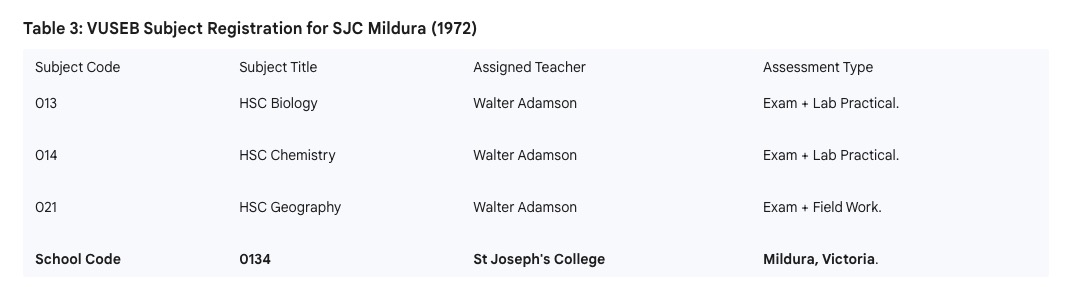
At the end of 1972, the Victorian Universities and Schools Examinations Board accepted my teacher returns for all three subjects. The formal public record — held today at the Public Record Office Victoria, VPRS 15584, School Code 0134 — lists my name against Biology, Chemistry, and Geography.
I found that record recently, with the help of AI. It is a strange thing, to find evidence of yourself at twenty-three, filed in a government archive, proving that something happened that you already knew had happened.
· · ·
The old nun and the moon
St Joseph's, 1972
During that year at St Joseph's, I met one of the oldest of the Sisters — a woman who seemed to my twenty-three-year-old self to be in her nineties. She carried the living memory of the community that had arrived in Mildura in December 1905 to establish the school (then known as the High School of Our Lady of Mercy) in what was then a remote irrigated farming settlement at the edge of the known world.
I have since identified her as almost certainly **Sister Mary Evangelist McBride**. While the original 1905 pioneer was also named Sister Evangelist (Sister Evangelist Mulvay, who died in 1922), the woman I met in 1972 was likely born around 1895. She had been a member of this community for decades and had witnessed the first triumphs and the first catastrophes of flight in the region.
She told me about the 8th of October, 1919, when the first aircraft reached Mildura. Lieutenants Douglas Fraser and Aloysius Yerbury flew low over Langtree Avenue — the main street — performing loops, drawing a crowd. She had watched from the corner of Pine Avenue and Tenth Street, directly under the flight path. Nobody in Mildura had ever seen an aeroplane before. And yet here was one, making impossible circles above the main street of a desert farming town.
Two months later, on 12 December 1919, a second aircraft came. Part of the government's Second Peace Loan Tour — a surplus wartime B.E.2e biplane (registration C6990) barnstorming over the main streets. Captain Clive Cook MC and Sergeant Mechanic Jack Hildred. The aircraft banked too steeply and stalled, nosediving into a large box tree at the Mildura Racecourse. Sergeant Hildred was killed instantly; Captain Cook died shortly after.
Then, just three months later, on 29 March 1920, a second fatal crash occurred — a Lieutenant William Valentine Herbert and Sergeant Frank Seymour Adams in an Avro 504K. Two aviation tragedies within four months, on the same ground she walked every morning.
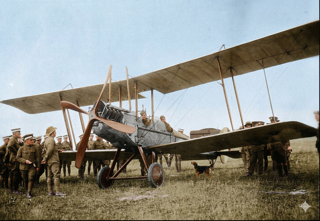
A BE2 biplane on the Second Peace Loan Tour, September 1919 — the same aircraft type as C6990, the serial number recovered from the Mildura wreckage. Original photograph from the State Library collection; colourised using AI by Walter Adamson. Colourising old photographs is one of the things I teach — this is what a century-old black-and-white image can become.
She had seen the first aircraft land in triumph and the later ones crash and kill their crews. At that time, the Sisters of Mercy were the town's primary nurses and pastoral care providers. In 1919, they were the ones who responded to the wreckage, extracting the bodies and caring for the living.
I asked her — this was 1972, three years after the moon landing — what she thought about men going to the moon.
She said she could accept man flying. But she could not accept man flying to the moon. She believed it was against God's will.
"I was twenty-three and a scientist and I did not share her theology. But sitting with her answer for fifty years has given me something."
I was twenty-three and a scientist and I did not share her theology. But sitting with her answer for fifty years has given me something I did not have at the time.
She was not ignorant. She was not irrational. Her rejection was rooted in a specific late 19th-century theological framework: the doctrine of the **Firmament**. In her formation, the heavens were two distinct realms. There was the lower atmosphere — a dangerous domain where man might eventually fly, but still within the created order. And there was the Celestial realm — the domain of the Divine, not to be entered by man. The moon was the boundary. Crossing it was not a technological achievement to her; it was the Tower of Babel, a human overreach into the domain of God that invited retribution. The 1919 and 1920 crashes had provided her with the empirical evidence of what happens when man reaches too far.
I have come to respect that more as I've got older. Most of us spend our lives not knowing where our edge is. She knew exactly where hers was and she had earned the right to it.
She had arrived in Mildura in 1905 by horse and carriage. She watched, in her lifetime, a man walk on the moon. That is not a small thing to ask a human nervous system to absorb. And she had absorbed it, all of it, from 1905 to 1972, and she had ended up in a modest room at St Joseph's College, talking to a twenty-three-year-old who was one chapter ahead of his Geography students and slightly amazed to be where he was.
I think about her a lot when I think about what it means to live through technological change at a speed the human nervous system was not designed for. She was ahead of all of us on that question.
· · ·
Dead-reckoning
Mildura Airport, 1971–72
During my time in the Sunraysia region I obtained my Private Pilot's Licence at Mildura Airport. The airport had been built in 1939 as a wartime training base. No. 2 Operational Training Unit had graduated 1,247 pilots there — flying Wirraways, Kittyhawks, Boomerangs, Spitfires, and Mustangs over the same flat country I was learning to navigate. They had logged 104,000 training hours. Forty-five of them had been killed in accidents over this territory.
By 1972 the base was civilian, and I was learning to fly a Piper PA-28-140 Cherokee in skies that had thirty years earlier been full of men preparing for the Pacific campaign.
There was no GPS. There was no VOR navigation for light aircraft. You flew by dead-reckoning: compass bearing, airspeed, elapsed time, and the landmarks below you. The irrigation channels of Sunraysia made excellent reference lines. The Murray River ran silver to the south. The grid of orchards and vineyards, measured and planted in rows, looked from two thousand feet like someone had been very patient with graph paper.
Dead-reckoning is a particular kind of navigation. You commit to a calculation based on what you know. You trust that calculation for a fixed period of time. You check it against visible reality when reality becomes visible again. You correct if needed. You commit to the next calculation.
It strikes me now that this is a reasonable description of how to navigate most things in life. You don't always know where you are going. You do know what you know, what direction you're heading, and how much time has passed. You check your position against what you can see when you can see it. You correct. You continue.
I was not trained to fly. I was taught to fly. An instructor showed me what to do, corrected me when I was wrong, then sent me solo. The skill I actually needed — the one nobody explicitly taught me — was learning to trust the instruments when my instincts told me something different. Instinct in a light aircraft in certain conditions will kill you. The instruments know things your body can't feel.
There was a moment in my training — I won't pretend it only happened once — when the horizon looked unfamiliar and the cockpit felt like a trap. I was briefly lost over the Mallee scrub. Flat grey-green in every direction. No river in sight. The temptation was to reach for the radio immediately. To ask someone else to fix it.
Instead, I remembered the rule every pilot learns and most people never have to use:
AviateNavigateCommunicate
In exactly that order. Always that order.
Aviate first. Keep the wings level. Don't let the crisis stall the airframe. A Cherokee is a stable machine — set the power, set the trim, and it wants to fly. The urgency I was feeling was mine, not the aircraft's. Separate the panic from the physics. The plane was fine. I was the variable.
Navigate second. Only once the plane was flying itself could I look at the map. I found what I needed: the silver glint of the Murray, far to the south. The irrigation grid, patient and exact as graph paper. I had drifted further left than I thought. A small correction. Problem solved.
Communicate last. The radio is not a lifeline. It is confirmation — the final step, not the first. Talking to someone else doesn't keep you in the air. It just adds noise to a brain already struggling with signal.
I found my way back to Mildura's long runway not because I was a natural pilot. I found it because I trusted the instruments more than my panic. I let the aircraft fly while I figured out where I was.
This turns out to be a reasonable description of how to approach most unfamiliar things in life. Don't let the strangeness stall you. Find your reference points before you ask for help. Only then reach out.
It is the method I now teach. Aviate: keep your own thinking going — don't hand over the controls the moment something feels unfamiliar. Navigate: check what AI finds against what you actually know and what the record confirms. Communicate: only then share what you've built. Three steps. Always that order. The Three-Source Rule is dead-reckoning for information — and dead-reckoning, it turns out, works just as well at seventy-five as it did at twenty-three.
Table 3: VUSEB Subject Registration for SJC Mildura (1972) — Public Record Office Victoria, VPRS 15584
A note on the archive. The formal record of my teaching at St Joseph's College Mildura in 1972 is held at the Public Record Office Victoria, VPRS 15584 — the VUSEB Teacher Returns, School Code 0134. It lists me as teacher of HSC Biology, HSC Chemistry, and HSC Geography. Research in 2026 has confirmed that the Sister I met was almost certainly Sister Mary Evangelist McBride (born c.1895). The community memory she shared included not one, but two fatal crashes within four months: the B.E.2e crash of Captain Cook and Sergeant Hildred on 12 December 1919, and the Avro 504K crash of Lieutenant Herbert and Sergeant Adams on 29 March 1920. Both are confirmed through Trove newspaper archives and RAAF historical records. I located all of this with AI's help — but I checked every fact against the official sources. That is the Three-Source Rule in action: ask the AI, then verify against the record and against what you already know.
What AI found when I went looking
Fifty years later
This year — 1972, Mildura, St Joseph's College — had been largely unknown to my family until recently. Not hidden deliberately. Just unlisted. It did not fit neatly into any official document. The decades that followed had their own logic: the University of New England, twenty years at BHP in information technology strategy, work in corporate planning and international business development. This chapter existed in a different register — the register of the personal, the provisional, the chapter before the chapters anyone expects to see.
A year or so ago, I sat down with an artificial intelligence and began to recover it. I want to be honest about what that process was actually like, because I think it is different from what most people expect.
It was not dramatic. It was archaeology. I told the AI what I remembered. The AI — working with what I gave it and a capacity to trace archival pathways I would never have found on my own — began to locate corroboration. It found the name of Associate Professor Jim Douglas, the UNSW mathematician and "natural teacher" who had personally written to the Vice Chancellor to clear my path to the University of New England. It helped me reconstruct the four meetings I had with Dr. Les Wright at his sheep farm while he tended fences, where he gave me the pragmatic advice that shaped my MSc thesis on "Machine Language Portability." It even located the dates of the anti-nuclear protest I attended in Boston in 1979 during a training mission for the new DEC 2030 computer.
The AI did not tell me anything about my life that I did not already know. What it did was verify it, contextualise it, and show me where it sat inside a larger history I had not previously been able to see. It showed me how my work in IT audit and strategy at BHP, or assessing the risk of the JORN radar project, was the direct descendant of the "dead-reckoning" I learned over Mildura. That is a different kind of knowing. It is the difference between remembering something and understanding it.
There was a moment in that process — I have heard this from others who have done similar things — where you realise that the chapter you thought was minor was actually foundational. That the year you didn't list anywhere was the year you learned the most important thing.
"The year you didn't list anywhere was the year you learned the most important thing."
For me, that thing was this: I am better at learning new things in public than at performing mastery in private. The Geography class taught me that. Flying taught me that. Even Sister Evangelist, without meaning to, taught me that — her willingness to say clearly what she believed and where her limit was, in front of a young man she had no reason to impress, was one of the more honest things I have ever witnessed.
Here is the thing I want you to understand: the process that recovered this story is exactly the same process I teach. You tell the AI what you know. You check what it finds against the official record. You verify with someone you trust. The subject changes — it might be a letter to your GP, or organising your week, or documenting the year your father built the house in Beaumaris. The method does not change. Dead-reckoning works whether you are navigating over Sunraysia or navigating your own Tuesday morning. If you are reading this on behalf of your parent — this is the kind of thing they could build, with their own memories, in their own voice.
Why I'm telling you this
You are reading this because you have stories like mine. I am confident of that.
Not necessarily in Mildura. Not necessarily involving a union blockade or an old nun with personal memories of 1919 or a Piper Cherokee over irrigation channels. But you have a year — probably more than one — that didn't make it onto any official document. A year where you did something you weren't qualified to do, for reasons that made complete sense at the time. A decision made for love, or instinct, or pure necessity, that turned out to be one of the most formative things that ever happened to you.
You almost certainly have people like Sister Evangelist — people who are now gone, whose stories only you carry. People who crossed more technological and social change in a single lifetime than any of the textbooks anticipated, and who absorbed it with a clarity about their own experience that most of us don't achieve.
And here is the thing about 2026: the tools now exist to help you find those chapters, verify them against the record, frame them properly, and turn them into something that can be passed on. To your children. To your grandchildren. To yourself, which is not a small audience.
AI does not give you your stories. You already have them. What AI can do — and what I have spent a considerable amount of time learning how to make it do well — is work with what you know and what you are genuinely curious about to help you build something that lasts. Not a technology course. Not a training in software. A way of thinking that extends what you can already do.
Sister Mary McAllen did not train me to be a teacher. She gave me a classroom and trusted me to learn. What I gave my students was not just the curriculum — it was a model of what it looks like when someone takes something seriously enough to keep going even when they're not certain. That is what is on offer here.
Not training. Teaching you how to learn.
Your Stories Are Waiting
Want to know if this is right for you or your parent?
Personal lessons in using AI to research, document, and tell the chapters of your life that don't appear on any résumé. One hour at a time. Starting wherever you are.
A 15-minute triage call costs nothing. I'll talk about what frustrates you most, how much support you currently need, and whether I can help. If it's not the right fit, I'll tell you honestly.
I am an unregistered NDIS provider. Self-managed and plan-managed participants only.
Capacity building under line item 15_035_0106_1_3.
My coaching fee typically
displaces $2,000–5,000 per year in Core Support costs.